MyLGHealth - Medical Reports Explained Instantly
Doctor-Reviewed AI Assistant For Understanding Health Reports
Upload your lab report or prescription at My-LGHealth.com and get a easy summary that will explain your complicated reports in few seconds, and it's AI powered.
Medical Disclaimer: MyLGHealth is for informational purposes only and does not constitute medical advice. Always consult a qualified healthcare professional before making any medical decisions.
MyLGHealth Services — Built for Every Patient
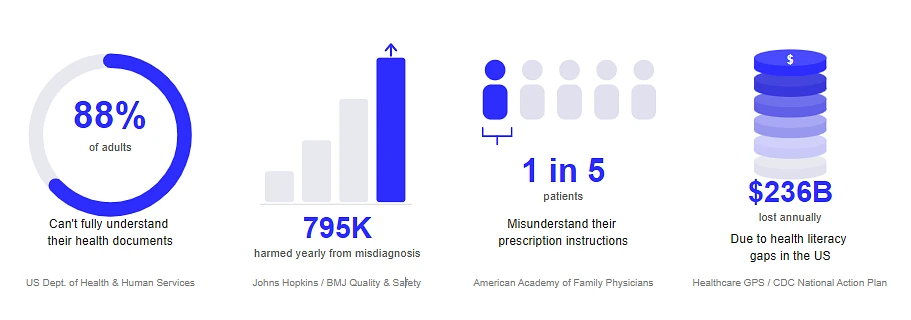
Majority of individuals believe that they can read a medical report. The truth is much worse than any one would think. The US Department of Health & Human Services notes that only a quarter of adult Americans are health literate to actually interpret what their lab results or prescriptions are telling them – 88% are reading numbers, abbreviations, and medical terminology that may as well be written in some other language. And this is not a mere inconvenience.
A major study published in BMJ Quality & Safety by Johns Hopkins researchers found that misdiagnosis alone causes an estimated 795,000 cases of permanent disability or death every year in the United States, with stroke, sepsis, and lung cancer being the most commonly missed conditions. The problem gets even more personal when you look at prescriptions. Research from the American Academy of Family Physicians found that patients routinely misunderstand the instructions printed right on their medication labels — over half of the errors involved getting the dosage wrong, and another 28% involved taking the medicine at the wrong frequency.
These are not fringe cases, approximately 1 in every 5 Americans has encountered a medication error in the course of care. When you magnify and see the financial losses, the figures are mind boggling. The annual cost of health literacy failures to the US healthcare system is estimated at 236 billion annually by data gathered using the CDC National Action Plan on health literacy. That money is spent on emergency visits, hospitalization and treatments that would not have happened had patients just understood what their documents were telling them in the first place. This is where MyLGHealth was created to bridge the gap.
National Assessment of Adult Literacy (NAAL), only 12% of U.S. adults have “proficient” health literacy.
MyLGHealth Services — Built for Every Patient
What we offer

Analysis

Summary

Support

& Secure
One Blood Test. Six Different Warnings. How My-lghealth.com helps :
It is not one test of one thing that that single tube of blood your doctor draws when he does a routine checkup. One of the most frequently ordered lab tests in the world is a CBC, which is also being screened by six branches of medicine at the same time. The very test that determines your hemoglobin level in case of anemia is also testing your white blood cells to detect infections, scan the signs of early blood cancers, measure the level of inflammation that is related to cardiovascular risks, detect platelet defects that influence clotting, and indicate abnormalities in the immune system that may predict autoimmune diseases. Six clinical paths on a single draw and all of them appear on a report with which most of the patients are not able to read beyond the first line. When you post a CBC to MyLGHealth, the AI doesn’t simply read your numbers back to you, but rather goes step by step through each of them and tells you what they mean in each of the specialties the AI intersects, the way your doctor would do so in half an hour rather than three.
About Us
Meet MyLGHealth — AI That Reads Your Health Documents
My LGHealth is an AI powered platform built to help everyday people understand their medical documents instantly. No more confusion about lab values or prescription instructions.
My-LGHealth gives you a clear plain language summary in seconds, in the language you prefer.
- Lab Reports & Prescriptions
- Multi-Language Summaries
- Instant Results in Seconds
- 100% Private & Secure
- No Registration Required
- Works on Any Device
How MyLGHealth works:
More than AI — built on real medical expertise by humans:
A large gap exists between an AI that reads medical text and one that comprehends what it is reading. The majority of AI tools input your report and execute it in a general purpose language model and regurgitate whatever it deems appropriate. MyLGHealth is not like that.
Thousands of actual medical records of lab reports, blood panels, prescriptions, diagnostic findings, etc. were scanned into our system and each reviewed and interpreted by a qualified physician. A doctor interpreted a CBC panel, and told a 45-year-old patient with no previous history what high levels of white blood cells indicate, and this interpretation became part of the way our AI learns to respond. When a different physician raised a red flag that the slightly low hemoglobin level in a pregnant woman needed an entirely different context than the same figure in a male athlete, that subtext was incorporated into the system as well.
This isn’t theoretical. Every summary pattern you see on MyLGHealth was shaped by actual clinical reasoning, not just language processing. Our medical team — led by Dr. Christopher R. Fox, MD as Chief Medical Officer — continuously monitors the quality of AI outputs, reviews edge cases, and updates the system when medical guidelines change. The AI doesn’t operate in a vacuum, it operates under ongoing physician oversight.
And about your privacy — when you upload a document, it gets processed entirely in server memory and deleted immediately after your summary is generated. We never store your file, we never see your report, and we have no record of what you uploaded. The only time any data gets retained is if you voluntarily choose to share your AI summary with the MyLGHealth community after analysis — and even then, your original document is never stored or shared. That choice is entirely yours, every single time.
The MyLGHealth Team — People Who Built mylghealth
Meet the passionate people behind My-LGHealth dedicated to making healthcare information accessible to everyone through mylghealth.
FOUNDER

Dr. Lynn A. Brody — Founder & CEO of MyLGHealth
Every time my mother received a lab report, she’d call me. Not because something was wrong — because she couldn’t tell whether something was wrong or not. She’d read out numbers over the phone, ask me what “ALT” means, whether her creatinine was too high, if that flagged value meant she needed to worry. I’d walk her through it in five minutes and she’d hang up relieved. But one day she asked me something that stuck — “what do people do who don’t have a doctor to call?” I didn’t have a good answer. Most people don’t have a physician in the family who can translate a lab report over the phone at 9pm. They sit with their results for days, anxious, confused, Googling things that make it worse. That question is the reason MyLGHealth exists.
Our Team Who Helped Us To Create This Awesome Free Community Service:

Dr. Christopher R. Fox, MD
Chief Medical Officer
Dr. Christopher R. Fox, MD brings years of clinical expertise to MyLGHealth, ensuring every AI summary meets real medical standards patients can trust.

Dr. Makram Gedeon, MD
Medical Advisor
Dr. Makram Gedeon, MD guides the my lghealth platform with deep medical knowledge, helping patients understand their health documents with confidence.

Dr. Leejee H. Suh, MD
Medical Advisor
Dr. Leejee H. Suh, MD ensures My-LGHealth delivers accurate, responsible health information that empowers patients to make informed decisions.
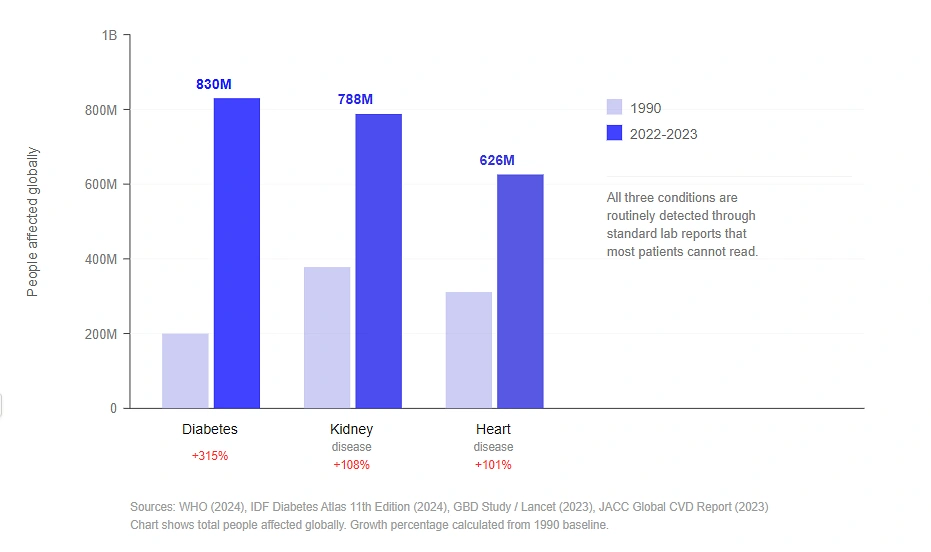
The three diseases that appear most in everyday lab tests diabetes, kidney disease and cardiovascular disease currently impact more than 2.2 billion people worldwide each. The number of diabetes cases alone increased to 830 million by 2022 and WHO estimates that over half of these individuals are not even taking medicine to control it yet still had it in 2022. In the same timeframe, kidney disease increased twofold, 378 million to 788 million as per the 2023 Global Burden of Disease published in The Lancet. The same pattern was experienced with cardiovascular disease which increased by 311 million up to 626 million.
All those conditions are either caught or missed with the help of the same lab reports which patients find it hard to read. Anemia is an early sign that a CBC flags which may indicate chronic kidney disease. A lipid panel displays cardiovascular risk with a number of cholesterol and triglycerides that do not mean anything to one without a medical background. An HbA1c test will reveal three-month blood sugar levels that will indicate whether or not a patient is prediabetic, diabetic, or well-controlled – but the number itself will not have any meaning without understanding what 5.7 vs 6.5 vs 8.0 really means to their health. It is not some special conditions which need special testing. They are filtered by the most widespread blood examination requests ordered on a daily basis in clinics all over the world and the patients who get the results of the said tests are simply too many to interpret them.
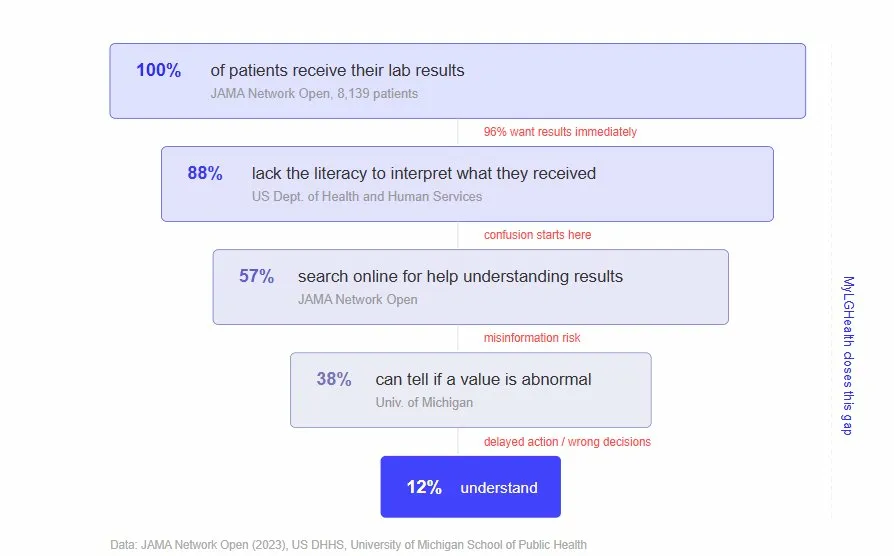
There’s a specific sequence that plays out millions of times a day across clinics and patient portals worldwide, and it almost always ends the same way. A patient gets their lab results, usually through an online portal or a printed PDF from their doctor’s office. A JAMA Network Open study of over 8,000 patients found that 96 percent of them wanted to see those results immediately, even before their doctor had reviewed them. So they open the file.
And then the breakdown starts. The US Department of Health and Human Services found that 88 percent of adults don’t have the health literacy to properly interpret what they’re looking at. So more than half of them — 57 percent according to the same JAMA study — go to Google, WebMD, or random forums trying to figure out what their numbers mean. Some of them end up more confused, some end up terrified over values that are perfectly normal, and some miss genuinely concerning results because they didn’t know what to look for. The University of Michigan tested this directly and found that only 38 percent of people with lower literacy could even identify whether a value was inside or outside the reference range. By the time all of that filtering happens, only about 12 percent of adults actually have the proficiency to understand their own health documents without help. That’s the gap MyLGHealth was designed to close — not replacing doctors, but making sure patients aren’t flying blind between the moment they receive a report and the moment they sit down in a doctor’s office.
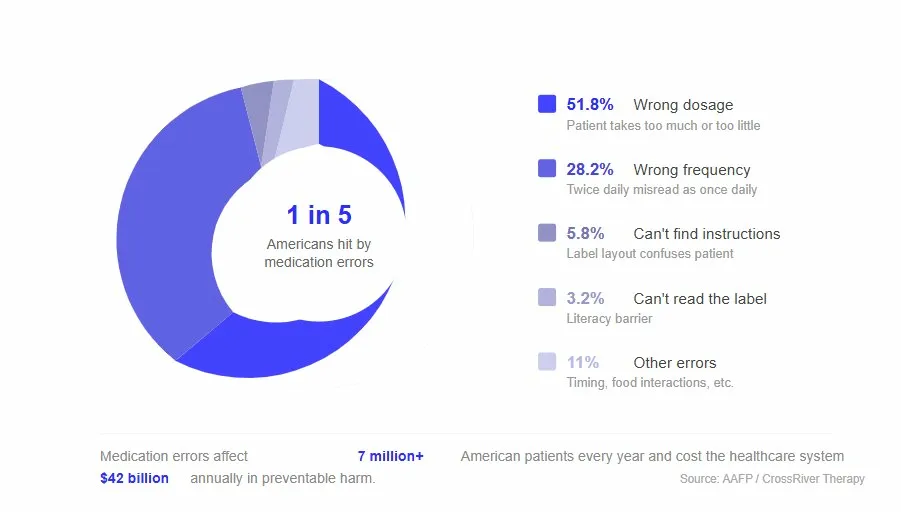
Prescriptions are supposed to be the simplest medical document you receive. A label tells you what to take, how much, and when. But research published by the American Academy of Family Physicians found that patients regularly misunderstand even these basic instructions. Over half of the errors — 51.8 percent — involved getting the dosage wrong, which means taking too many pills or too few. Another 28 percent involved frequency errors, where a patient misreads “twice daily” as once, or confuses “every 8 hours” with “three times a day” when those aren’t always the same thing depending on your sleep schedule.
In the study, almost 6 percent of the patients were unable to locate the instructions stated on the label and approximately 3 percent confessed not to be able to read the label. These figures are even worse in cases of patients taking several medications, which is exceptionally widespread – the elderly patients who have to take care of their diabetes, blood pressure and cholesterol levels may have 5 or 6 medications with different doses, time schedule, and food compatibility conditions. Medication errors have occurred in one in five Americans who have at some point in their care, and the costs of such preventable errors amount to over 42 billion yearly. The prescription summary tool on MyLGHealth technology reads your prescription card and displays each drug in a simple language as to what it serves, how to take it, when to take it, and what to be aware of. It does not substitute the advice of your pharmacist but is a readable backup which you can consult at any time.
Your Data Is Protected — No Matter From Where You Are
MyLGHealth can be used by people of all the countries, to comprehend their medical documents. You can be in New York, Karachi, London, Dubai or Sydney and your data receives the same protection, as that is how we have always planned the system.
MyLGHealth runs all the documents in memory in the server. There is no writing to a database, no saving to a disk, no logging. As soon as you generate your summary, your uploaded file has disappeared. No account to open, no personal data to submit, no health record on our servers to be hacked. We constructed it so intentionally, so that it can not be leaked, unless we do not store it.
This is in line with key data protection systems across the globe. To United States users, our zero-storage model is more than what HIPAA demands of the non-covered entities, since there is literally no safeguarded health data stored on our side. To the users in the European Union, our processing model adheres to the fundamental principles of GDPR, including data minimization, limitation of purpose, and the right to erasure as it automatically occurs after the analysis because nothing is stored after analysis. In the Australian market, our Australian privacy practices align with the Australian Privacy Principles of the Privacy Act 1988, especially in regard to minimizing the collection and maintaining data that is not retained longer than it is required. This can be applied to users in the Middle East, South Asia, or any other place as well – when you are not storing your data, then most privacy concerns are by design immaterial.
We also cover summaries in English, French, Spanish, Germa, Urdu, Hindi, Arabic, Chinese and all other major languages and as such, you will be able to know your results in the language most comfortable to you to read. Your health information shouldn’t require a translation on top of a translation.
Get Your mylghealth Summary in 3 Simple Steps
No sign up, no waiting, no confusion. Just upload your document and let mylghealth do the work instantly.
How It Works
Step 1 — Upload Your File
Drag and drop or browse to upload your lab report or prescription to My-LGHealth. Supports PDF, JPG and PNG up to 5MB.
Step 2 — MyLGHealth Reads & Analyzes
Our AI powered by Llama 4 Scout reads every value, graph, table and text in your document with human-like understanding.
Step 3 — Get Your Plain Summary
Receive a clear structured summary from My LGHealth in plain English or your preferred language. Understand your health in seconds.
Still have questions after your report?
Understanding your summary is one thing. Knowing what to do next is another. A lot of people get their MyLGHealth results and feel relieved that they finally understand what their numbers mean, but then a new kind of uncertainty kicks in — should I be worried about this value? Do I need to see a specialist? What tests should I ask for? Is this something I need to act on right now or can it wait?
That's exactly why MyLGHealth offers direct access to verified medical professionals. When you request a consultation, you're not picking a random doctor from a list — our team matches you with a specialist who's actually relevant to your condition. If your report shows thyroid concerns, you'll hear from an endocrinologist. If it's a blood panel with cardiac markers flagged, a cardiologist reviews it. The idea is straightforward: the right doctor for the right problem.
This isn't a treatment service and it's not a replacement for your primary care physician. What it is, honestly, is a guided first step. The doctor reviews your AI summary and your reports, explains what the findings mean in your specific context, tells you what diagnostic steps to consider, and helps you understand how to start a conversation with your local healthcare provider. A lot of patients — especially those in areas where specialist access is limited or wait times stretch into months — just need someone qualified to point them in the right direction. That's what this does.
You share only what you're comfortable sharing. The consultation is based on your AI-generated summary, not your original document, and our doctors follow the same privacy standards that apply across the entire MyLGHealth platform.
Frequently Asked Questions About mylghealth
Early detection starts with understanding your report
Early detection starts with understanding your report
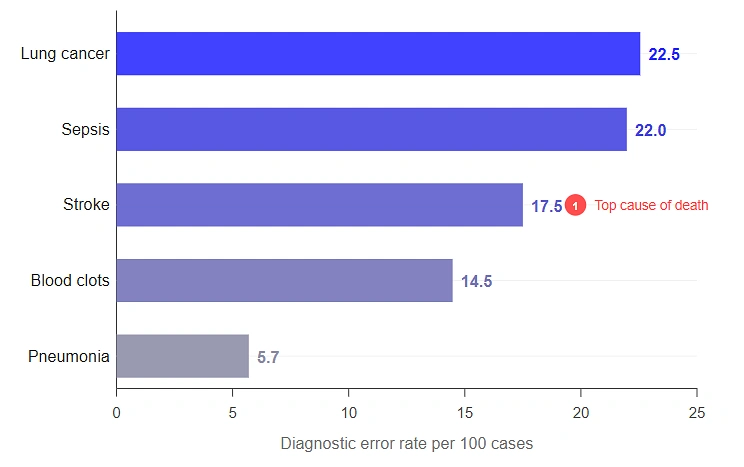
These 5 conditions account for 300,000 serious harms annually in the US. Vascular events, infections, and cancers represent 75 percent of all diagnostic harm.
FAQs
Frequently Asked Questions About mylghealth
Why can't I just read my lab report myself?
Most people assume they can, but research from the US Department of Health & Human Services found that only 12% of adults have the health literacy needed to properly interpret medical documents. Even people who read well struggle with medical terminology, reference ranges, and understanding whether a value actually needs attention. A University of Michigan study found that only 38% of people with lower literacy skills could tell whether a lab result was inside or outside the normal range.
Is the AI summary accurate enough to trust?
MyLGHealth's AI was trained on thousands of real medical documents with responses individually reviewed by qualified physicians. Our Chief Medical Officer and medical advisory team continuously monitor output quality. That said, we always recommend using the summary as a starting point for understanding — not as a final diagnosis. If anything looks concerning, consult your doctor with your summary in hand. You'll be able to ask better questions because you'll actually understand what your report says.
What happens to my file after I upload it?
Nothing — because we delete it. Your document is processed entirely in server memory and removed the moment your summary is generated. We don't store it, we don't log it, and we have no record of what you uploaded. The only exception is if you voluntarily choose to share your AI summary with the community after analysis, and even then your original document is never stored.
Can I use this for someone else's report — like my parent or child?
Absolutely. A large number of MyLGHealth users upload reports on behalf of elderly parents, children, or family members who can't navigate medical documents themselves. In fact, a JAMA Network Open study found that 57% of patients who received lab results online immediately went looking for additional information to help them understand what they were reading. MyLGHealth gives you that understanding instantly, whether it's your report or someone you're helping care for.
What if the AI misses something or gets it wrong?
No AI system is perfect, and we're transparent about that. MyLGHealth is designed to explain what your report contains in plain language — it identifies values, flags what's outside normal ranges, and explains what each test measures. But it doesn't replace a doctor's clinical judgment, which takes into account your full medical history, symptoms, and physical examination. If something in your summary concerns you, our Consult a Doctor feature connects you with a verified specialist who can review the findings in your specific context.
Why do I need this if my doctor already explains my results?
In theory, your doctor explains everything. In practice, a study published in JAMA Network Open surveyed over 8,000 patients and found that 96% preferred seeing their results immediately online — even before their doctor reviewed them. People don't want to wait days or weeks for an appointment to find out what their blood work says. MyLGHealth bridges that gap by giving you an understandable summary the moment you receive your report, so when you do see your doctor, you're walking in informed instead of confused.

MyLGHealth is a free AI-powered health document reader. Upload your lab report or prescription and get an instant plain language summary, privately and securely.
2026 @ my-lghealth